Find out how barefoot shoes with a wide toe box help with hallux valgus. Why narrow shoes are harmful, how the natural function of the foot is restored, and what exercises promote healthy feet.
Hallux valgus – a disease of the feet caused by modern lifestyles
Hallux valgus, also known as bunions, is one of the most common deformities of the front part of the foot. It is a condition in which the big toe gradually deviates toward the other toes, while the first metatarsal joint deviates in the opposite direction – away from the body axis. The result is a characteristic "bump" on the inside of the foot, which can cause pain, inflammation, limited movement, and later deformation of the entire foot.
It is estimated that 20 to 30% of adults suffer from this problem, with the incidence being significantly higher in women. The type of footwear plays a key role in this, especially narrow shoes with high heels and narrow toes, which deform the natural shape of the foot over time.
In recent years, more and more experts, physiotherapists, and enthusiasts of natural movement have been turning to an alternative solution – barefoot shoes, i.e., shoes that mimic walking barefoot. Their main principle is to respect the anatomy of the foot and allow it to function naturally.
Causes and mechanism of hallux valgus
Hallux valgus does not develop overnight. It is a long-term process involving a combination of several factors:
- Genetic predisposition – some people have a congenital weakness of the ligaments or a wider front part of the foot, which increases the risk of deformation.
- Unsuitable footwear – narrow toes push the toes together and prevent them from spreading naturally. Long-term pressure changes the axis of the big toe and deforms the joint.
- High heels – shift the body's center of gravity forward and increase pressure on the front of the foot.
- Weakening of the foot muscles – lack of natural movement leads to atrophy of the small muscles that hold the toes in the correct position.
- Other factors – such as being overweight, prolonged standing, pregnancy, or hormonal changes.
The result is a loss of stability in the big toe joint and a change in walking mechanics. The foot widens, the toes overlap, and pain makes everyday activities uncomfortable.
Barefoot as a path to natural foot function
The barefoot philosophy is based on a simple principle: the foot is a perfect mechanism in itself that does not need artificial support or cushioning as long as it has enough space and can move naturally.
Barefoot shoes are designed to restrict the foot as little as possible:
- they have a wide toe box that respects the natural shape of the toes,
- zero drop – i.e. no height difference between the heel and toe,
- a thin and flexible sole that allows you to feel the surface under your feet and activate the muscles of the foot,
- they are lightweight and without arch support, thus promoting natural strengthening.
Regular wearing of barefoot shoes improves posture, activates the muscles of the foot, and restores proper walking biomechanics. All of this has a positive effect on the prevention and slowing of the progression of hallux valgus.
How wide-toe shoes help
The most important feature of barefoot shoes for treating hallux valgus is a sufficiently wide toe box. This allows the toes, especially the big toe, to assume a natural position—pointing forward, not inward.
In narrow shoes, the toes are pressed together for long periods of time, which causes:
- pressure on the metatarsophalangeal joint (big toe joint),
- shifting of the big toe towards the other toes,
- rotation of the bones in the forefoot and a change in the axis of the foot.
In contrast, in a wide toe box, the toes can spread out and act as a stabilizing base for the body. The big toe can return to its axis, which reduces pressure on the affected joint and improves stability when standing and walking.
Long-term wear can result in:
- relief of tension in the toe area,
- improved blood circulation and reduced inflammation,
- strengthening of the small muscles of the foot that stabilize the arch and joints,
- improved balance and coordination.
However, it is important to emphasize that barefoot shoes are not a cure, but a tool to support rehabilitation. In cases of advanced deformity, their implementation should be gradual and combined with exercise or physical therapy.
Why start walking in barefoot shoes? Read 6 reasons that will convince you to buy your first pair of barefoot shoes. From comfort to health.
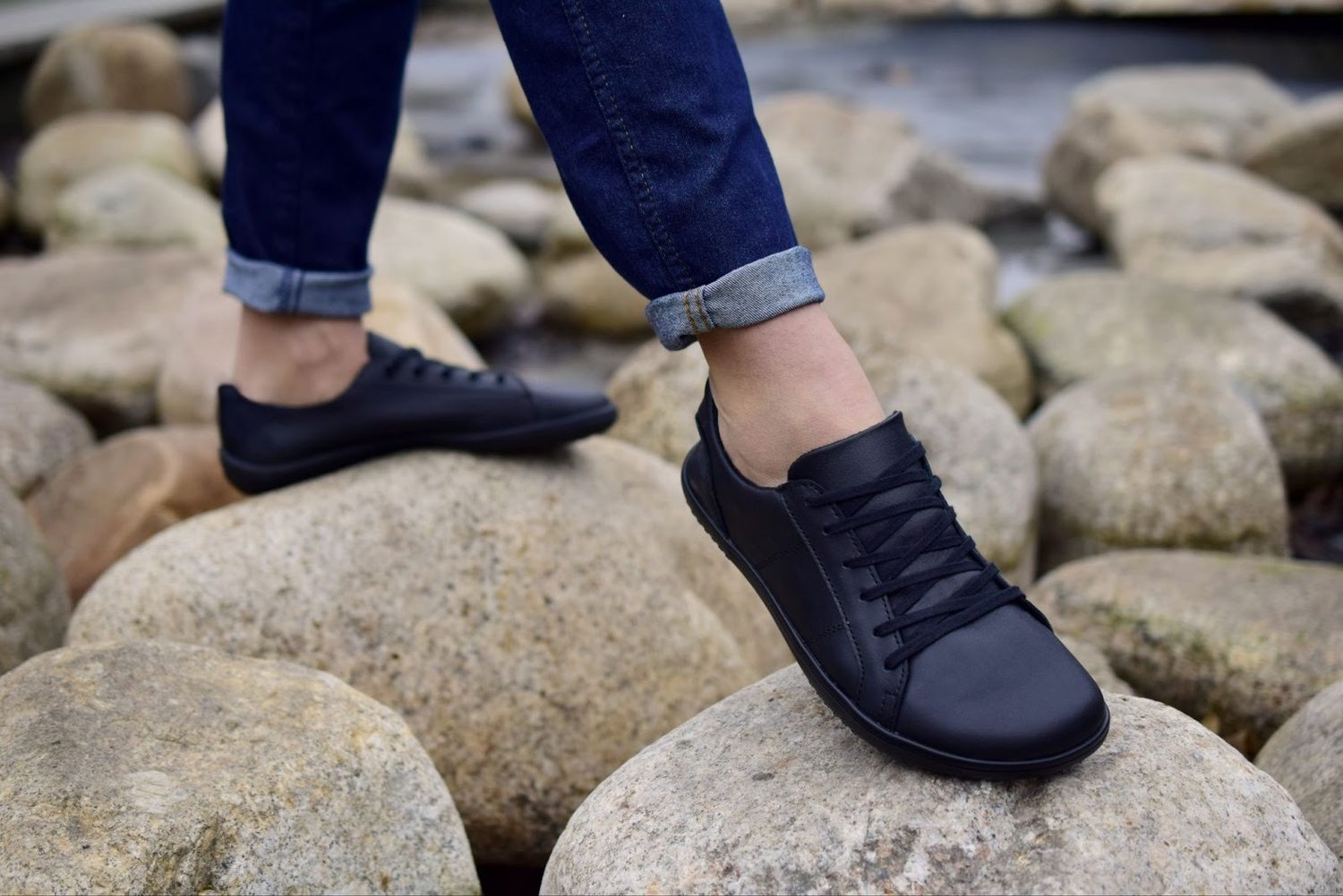
Source: Own
Supportive exercises and rehabilitation
Barefoot shoes are most effective when combined with an active approach. Physical therapists recommend regular exercises to strengthen the muscles of the foot and restore the correct position of the big toe, such as:
- stretching the toes (consciously spreading and stretching them),
- grasping objects with your toes (e.g., a towel, pencil),
- rolling your foot over a massage ball or roller,
- walking barefoot on different surfaces – grass, sand, gravel,
- using toe spacers as a temporary aid.
These activities help restore mobility, activate weakened muscles, and stabilize the front of the foot. Together with barefoot shoes, they form a comprehensive approach to treating hallux valgus.
Find out how to start running in barefoot shoes without injury. A guide to transitioning to barefoot shoes.
What to watch out for when switching to barefoot
The transition to barefoot should be gradual. Feet that have been accustomed to support and cushioning for years need time to adapt to a new way of moving.
Physiotherapists' recommendations include:
- Start with short intervals – 30 to 60 minutes a day.
- Alternate barefoot with regular shoes during the adaptation period.
- Choose shoes with enough space for your toes, not just width.
- Supplement barefoot walking with exercises and foot massages.
- If you experience pain, consult a physical therapist or orthopedist about changes.
When done correctly, barefoot shoes can significantly improve walking comfort, reduce pain, and in some cases even visually reduce bunions.
The path to healthier feet
Hallux valgus is not just an aesthetic problem – it is a sign that the foot has lost its natural function. Modern lifestyles, lack of exercise, and unsuitable footwear exacerbate this disorder.
Barefoot shoes represent a return to nature – they allow the foot to breathe again, move and fulfill its biomechanical role. Their wide toe box, flexibility, and zero drop promote proper weight distribution, strengthen the muscles of the foot, and reduce pressure on the big toe joint.
Although barefoot shoes are not a universal solution for everyone, for many they can be an effective way to stop the progression of hallux valgus, reduce pain, and restore a healthy relationship with their feet. However, the key is patience, gradual progress, and a comprehensive approach that includes movement, exercise, and respect for the body's anatomy.
 Czech barefoot brand
 Return within 14 days
 € - EN
 Čeština
 Deutsch (DE)
 Deutsch (AT)
 Slovenčina
 Magyar
 български
 Nederlands
 Français
 Hrvatski
 Italiano
 Italiano
 Polski
 Română
 Slovenščina


