Find out how to start running in barefoot shoes without injury. Learn the correct foot strike technique (midfoot), increase your cadence, and awaken the natural power of your feet. A guide to transitioning to barefoot shoes.
Why is cushioning actually bad for us?
For years, sneaker manufacturers have promised us that the more cushioning and support, the better. They presented shoes as armor to protect our feet from the "dangers" of hard surfaces. But what if it's quite the opposite?
The human foot is a masterpiece designed for running. It has 26 bones and a hundred muscles designed to work as a perfect natural spring and shock absorber. Stiff, overly cushioned shoes numb this spring. We force our feet to land on our heels with our legs straight because the cushioning alleviates pain. But this sends a shock wave straight to our knees, hips, and spine.
Angles barefoot shoes change that. Our minimalist shoes are the gateway to natural, quiet, and powerful running. They don't give you support from the outside; they awaken the strength within.
How Angles help you run differently
The magic of barefoot shoes lies in the fact that they immediately teach you better technique. Switching to Angles' ultra-thin soles is like taking a course in proper running technique, led by your own body. If you run incorrectly, the shoe will immediately "tell" you.
The running revolution in three steps:
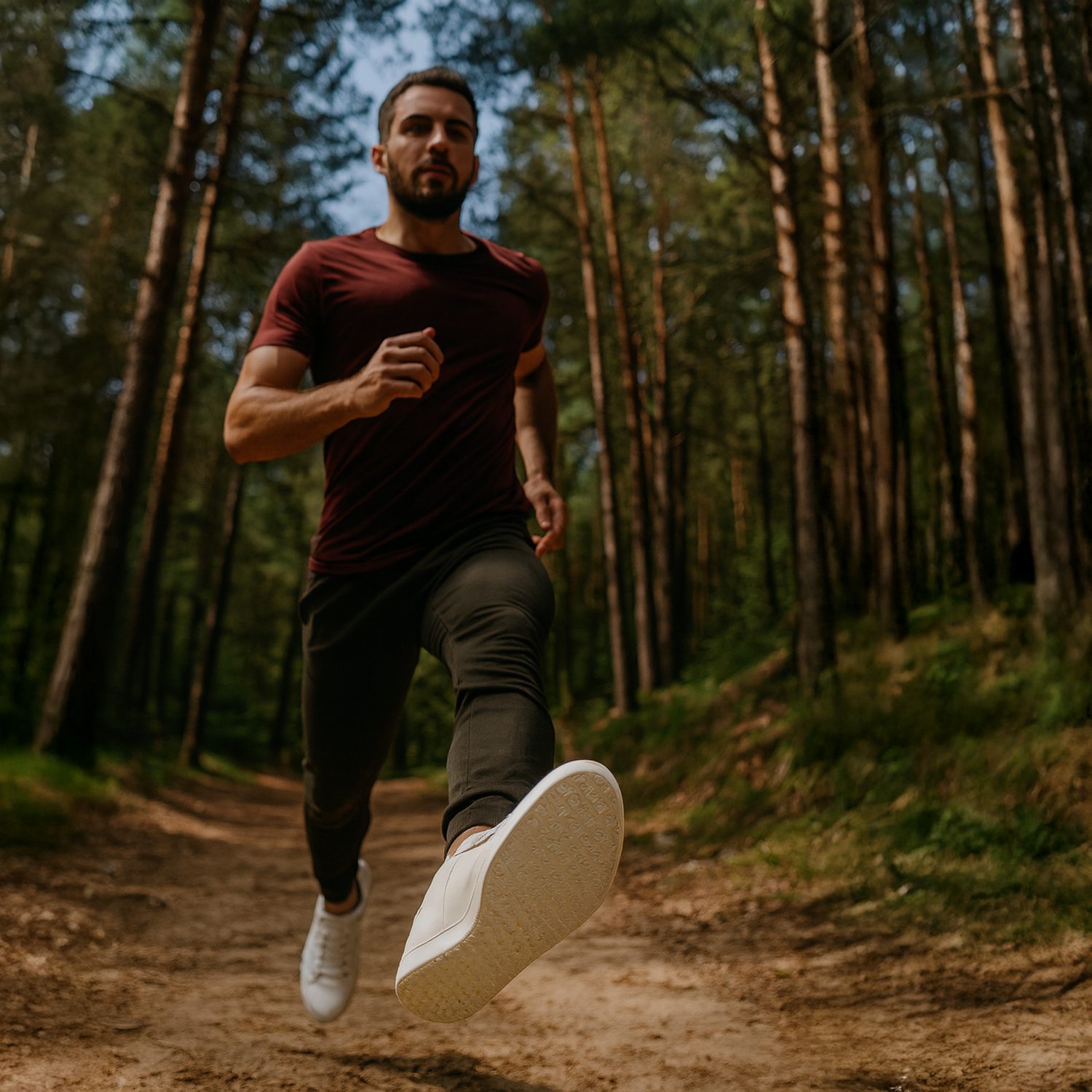
Change your foot strike (from heel to midfoot)
In regular sneakers, most people land on their heels. In Angles barefoot shoes, your foot instinctively avoids doing this because it would be uncomfortable. You will start landing on the middle or front part of your foot.
- Why? This foot strike automatically engages the calf muscles and Achilles tendon. These muscles tense like a string, absorbing the impact and gently distributing the force throughout the body instead of sending it to the joints.
Be quiet (step like a feather)
Your new mantra is silence. Focus on making your footfall in Angles shoes as quiet as possible, as if you were running on leaves.
- Why? A quiet step means a soft footfall. If you hear stomping, you are landing too hard and too far in front of your body. Silence is the best indicator that you are using your own muscles to cushion the impact correctly.
Shorten your stride (increase your cadence)
Focus on making your strides shorter and faster (ideally, your stride frequency should be higher than 170 per minute).
- Why? A shorter stride means that your foot lands directly under your body's center of gravity. This minimizes the so-called braking effect that occurs when a runner "sticks" their foot out in front. Shorter and faster strides are much more economical for the body and less stressful on the joints.
Did you know that 170 steps per minute is an average to slightly above-average cadence for recreational runners? For elite runners, this cadence is higher than 180 steps per minute.
Source: Own processing
How to start wearing Angles barefoot shoes without injury
The transition to minimalist running requires patience. The muscles of the feet and calves, which have been protected by thick foam for years, need to be rebuilt. If you rush, you risk overuse injuries, especially Achilles tendonitis.
Phase 1: Adaptation and a sensible start
- Walking before running: First, get used to wearing Angles shoes for normal walking. Wear them for an hour a day, gradually increasing the time. This will awaken the dormant muscles of your feet and give them time to adapt to the zero drop (heel and toe at the same height).
- Radically reduce the volume: If you are an experienced runner, limit your first runs in Angles barefoot shoes to just 5-10 minutes of jogging. At the beginning, the rule is: reduce your usual weekly mileage by 90%.
- Choose a soft surface: Start on grass, sand, or a forest path. Soft terrain forgives mistakes in technique, while the foot gains proprioceptive stimulation (it learns to perceive the terrain).
Phase 2: Patiently increasing and strengthening
- Slow addition: Increase the length of your run in Angles shoes by a maximum of 10% per week. If you run for 10 minutes, run for 11 minutes the following week. Yes, that slow!
- Alternate shoes: Still have your old shoes? Use them for long runs. Alternate them with barefoot shoes. This gives your muscles time to recover and helps prevent overload.
- Strengthen your feet. Include foot-focused exercises in your routine:
- Lifting with your toes: Pick up small objects from the ground with your toes (e.g., pencils).
- Walking on your toes and heels: Exercise your calf strength and mobility.
- Stretching your calves: Stretch them thoroughly after each run, as they are working much harder than before.
Remember: Your body's signals are your compass
During the transition, it is normal to experience muscle soreness in your feet and calves. This is a good thing – your muscles are building. However, sharp, stabbing pain (especially in the Achilles tendon, under the arch, or in the instep) means that you are going too fast. Take a break and return to barefoot running later, when your muscles have recovered and strengthened.
Angles give you the opportunity to get rid of pain and chronic injuries. They only require one thing: respect and patience. Unlock the power that has been in your feet for millions of years. Run with Angles barefoot shoes and feel free again. Choose from our range of high-quality barefoot shoes.
 Czech barefoot brand
 Return within 14 days
 € - EN
 Čeština
 Deutsch (DE)
 Deutsch (AT)
 Slovenčina
 Magyar
 български
 Nederlands
 Français
 Hrvatski
 Italiano
 Italiano
 Polski
 Română
 Slovenščina


